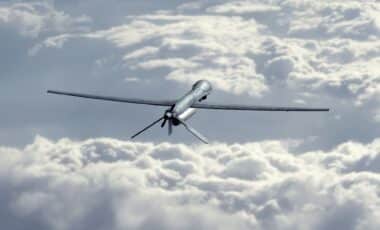

Russia has further modified its Shahed-136 drones, incorporating MANPADS (man-portable air defense systems), significantly boosting the drone’s ability to target Ukrainian helicopters. This new development follows previous alterations and marks a continued effort by Russia to evolve its drone capabilities.
The Shahed-136, originally an Iranian design, is widely used by Russia in its ongoing conflict with Ukraine. Known for its long-range and one-way strike capability, it was initially a simple, explosive-laden drone intended to hit fixed targets. However, with this new modification, the drone is equipped with shoulder-fired heat-seeking missiles, allowing it to target fast-moving aerial threats, including helicopters.
Exclusive Sneak Peek: The U.S. Army’s Game-Changing M1E3 Abrams Tank Revealed
Russian Adaptations of the Shahed-136 Drone
According to The War Zone’s report, Russia has begun equipping its Shahed-136 drones with Igla-S MANPADS, a heat-seeking missile that can engage Ukrainian aircraft. Known in Russia as the 9K388 and to NATO as the SA-24 Grinch, the missile has an impressive range of about 3.7 miles, with an improved infrared seeker and a heavier warhead compared to older models. This missile, mounted on the drone, provides a significant defense mechanism against Ukrainian helicopters like the Mi-8 and Mi-24, which are regularly deployed to intercept Shahed drones.
The Igla-S has become one of the most widely used missiles in the Russian arsenal due to its reliability and capability to engage a variety of aerial threats. While the drones’ primary purpose remains offensive, the addition of air defense systems dramatically increases their survivability, allowing them to better evade interception. According to reports, these modified drones can be operated remotely by Russian forces, with the missile launched from a distance via a radio-frequency modem.
Enhancing the Drone’s Self-Defense Capabilities
In addition to the missile modification, there are indications that the Shahed-136 drones are being further adapted to improve their overall operational effectiveness. Infrared countermeasures are being added to the drones, aimed at confusing and neutralizing the tracking systems of enemy interceptors and missiles.
These systems are installed at the rear of the drone, emitting strong infrared signals that can disrupt the targeting efforts of incoming threats. This makes it harder for Ukrainian forces to successfully target and intercept the drones, further enhancing their defense capabilities.
This adaptation is part of a broader trend in Russia’s development of loitering munitions and UAVs. With these new modifications, drones like the Shahed-136 are no longer just one-way attack vehicles but are being reimagined as multi-purpose platforms that can operate in a wider range of scenarios.